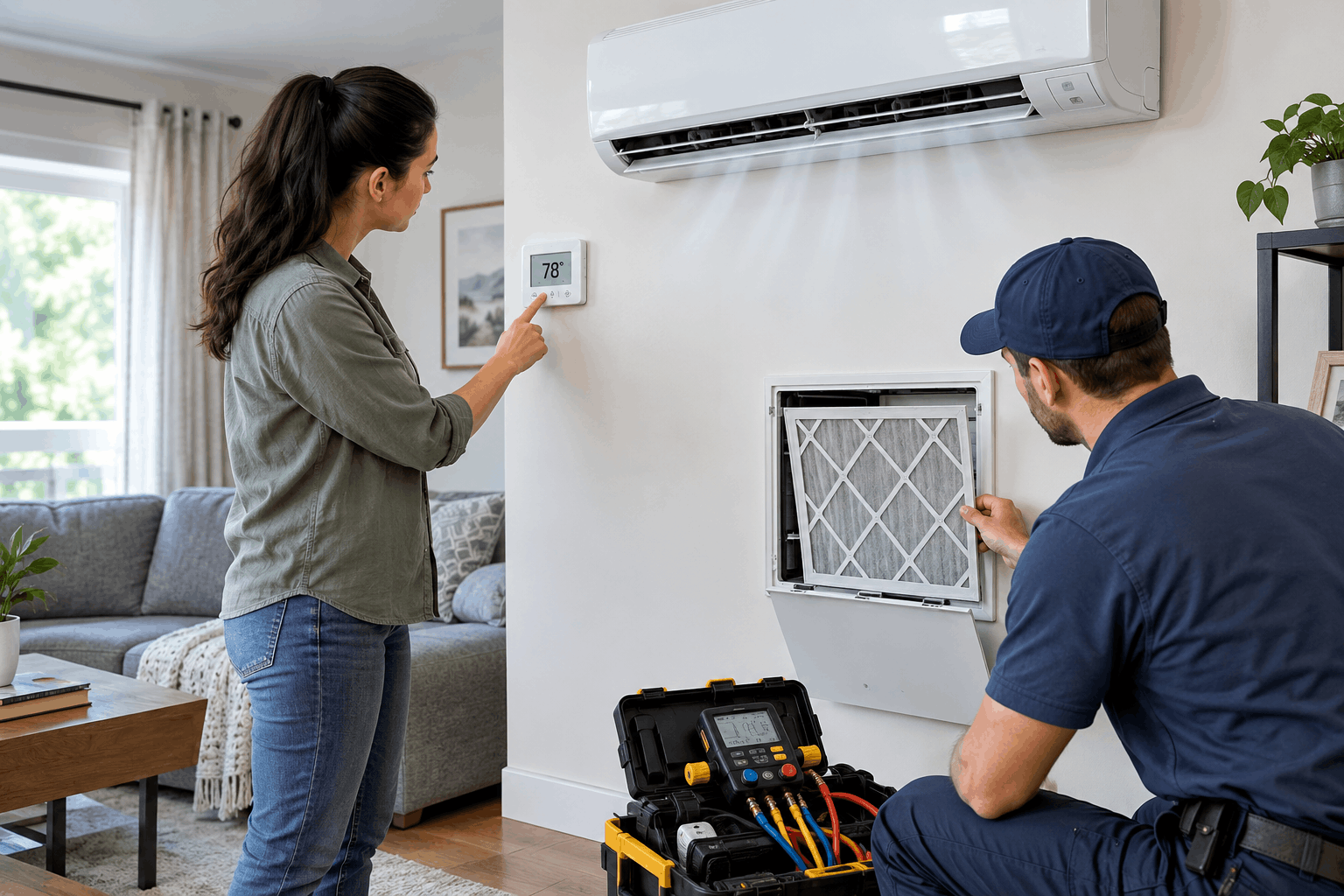
When your AC stops cooling properly, first check the thermostat settings, accessible air filter, and whether anything is blocking normal airflow. If the system continues running without cooling effectively, develops unusual noises, leaks water, or repeatedly loses performance, the next step is usually professional AC diagnosis rather than attempting technical repairs yourself.
An air conditioner can lose cooling performance for several reasons. Some are related to simple maintenance or settings, while others involve components that require an HVAC or AC technician. Observing the symptoms carefully can help you explain the problem and arrange the right type of service.
AC Stops Cooling Properly: What Should You Check First?
Before assuming that the cooling system has suffered a major failure, make a few basic checks that do not require opening technical components.
Confirm the Thermostat Settings
Start with the thermostat or AC controller.
Make sure the system is set to cooling mode and that the selected temperature is lower than the current room temperature. Also check whether another household member has changed the settings.
Then observe the system for a short period.
Is the AC running? Is air coming from the vents? Does the air feel cool, or is the unit simply circulating room-temperature air?
These observations provide useful information if a technician later needs to investigate the problem.
Look at the Accessible Air Filter
Restricted airflow can affect cooling performance.
If your AC has a filter designed for routine homeowner access, check its condition. A visibly dirty filter may need cleaning or replacement according to the equipment manufacturer’s instructions.
Do not dismantle panels or reach into technical parts of the system simply to investigate further.
After dealing with an accessible filter, check whether airflow and cooling improve. If the room remains warm, the problem may lie elsewhere.
Check for Blocked Airflow
Make sure curtains, furniture, boxes, or other objects are not obstructing accessible vents or air outlets.
Compare airflow in different parts of the property as well. Strong airflow in one room but noticeably weak airflow in another can be useful information when describing the problem.
The objective is not to diagnose internal ductwork or equipment yourself. It is to identify obvious external restrictions and document how the system is behaving.
Why Would an AC Run but Not Cool the Room?
An AC can appear to operate normally even when something is preventing effective cooling.
Several broad issues can produce similar symptoms.
Restricted airflow: A dirty filter or another airflow problem can reduce the amount of conditioned air reaching the room.
Control problems: Incorrect thermostat settings or a control-system fault may affect how the AC responds.
Drainage issues: Air-conditioning systems produce condensation. A drainage problem may cause moisture or water to appear around indoor equipment.
Mechanical faults: Fans, motors, compressors, and other components can develop problems that require professional inspection.
Refrigeration-system problems: Issues involving refrigerant or related components require suitable technical expertise and should not be treated as a DIY repair.
Because several different faults can result in weak cooling, the symptom alone does not establish the cause.
When Is Weak Cooling a Sign You Need an AC Technician?
If the thermostat, accessible filter, and obvious airflow obstructions appear normal but cooling remains poor, professional diagnosis becomes more appropriate.
Other reasons to arrange an inspection include:
- The AC runs continuously without reaching the expected temperature
- Airflow becomes unusually weak
- Cooling performance repeatedly improves and worsens
- The system switches off unexpectedly
- Unusual noises begin during operation
- Water repeatedly appears around the indoor unit
- One area remains much warmer than others
- The same problem returns after basic maintenance
At this stage, repeatedly switching the system off and on or experimenting with internal components may not reveal the actual fault.
Instead, describe the symptoms clearly and pass the problem to someone who works with cooling systems.
When professional assessment is needed, a multi-category service platform can help residents connect with local home service professionals for AC-related problems and other household maintenance needs. This is useful when the issue has moved beyond basic homeowner checks and requires an appropriate technician.
What Should You Tell the AC Technician?
A good service request describes what is happening rather than guessing what has failed.
For example, saying “the compressor is broken” assumes a diagnosis. A clearer description would be:
“The AC turns on and airflow is present, but the room no longer gets as cool as before.”
Before booking a technician, note details such as:
- When the cooling problem started
- Whether the AC turns on normally
- Whether airflow feels normal or weak
- Which rooms are affected
- Whether the problem is constant or intermittent
- Any unusual sounds
- Any visible moisture
- Any displayed error message
- Recent filter cleaning or maintenance
These details give the technician a more useful starting point.
Should You Keep Running an AC That Is Not Cooling?
There is no single answer for every cooling problem because the symptoms matter.
If cooling has simply become weaker and there are no obvious warning signs, you can document the problem and arrange an assessment if normal performance does not return.
However, potentially unsafe symptoms deserve more caution. Burning smells, visible electrical damage, significant water near electrical components, or other concerning conditions should not be investigated through repeated operation.
In those situations, avoid interacting unnecessarily with the equipment and seek appropriate professional help.
Can a Dirty Filter Cause an AC to Stop Cooling Properly?
A heavily restricted filter can contribute to poor airflow and reduced cooling performance, which is why checking an accessible filter is a sensible early step.
However, replacing or cleaning a filter does not solve every cooling problem.
If airflow remains weak or the AC still does not cool after routine filter maintenance, avoid assuming that another simple DIY fix will solve the issue. The system may require inspection.
This distinction matters because homeowners can safely perform certain routine tasks without treating technical HVAC diagnosis as ordinary maintenance.
What if Only One Room Is Not Cooling?
Uneven cooling provides a different clue from a complete loss of cooling.
If most rooms feel normal but one remains warm, first check whether the accessible vent is open and unobstructed. Consider whether curtains, furniture, or another object is interfering with airflow.
Also note whether the problem is new.
A room that previously cooled normally but suddenly becomes much warmer may justify further investigation, particularly if airflow has changed.
Avoid opening ducts or attempting technical modifications yourself. Simply record which rooms are affected and whether airflow differs between them.
Routine Maintenance Can Help You Notice Changes Earlier
Routine AC care is not a guarantee against future faults, but it makes changes in system performance easier to notice.
Keep track of basic maintenance such as accessible filter cleaning or replacement, along with any professional servicing performed on the system.
Pay attention to gradual changes too. Cooling may become less effective over time rather than disappearing suddenly. Airflow can weaken, new noises can develop, or moisture can begin appearing occasionally.
Recognizing those changes gives you useful information before the problem becomes a complete cooling failure.
Know When Basic Checks Are Enough
When an AC stops cooling properly, start with simple observations rather than technical repairs. Confirm the thermostat, inspect the accessible filter, check for obvious airflow obstructions, and note exactly how the system behaves.
If those checks do not restore normal cooling, the problem may require professional diagnosis. An AC technician can assess whether the cause relates to airflow, controls, drainage, mechanical operation, refrigeration components, or another part of the system.
The most useful approach is to know where basic homeowner maintenance ends. Once the cause is unclear or technical work is required, accurate symptom reporting and appropriate professional assessment are safer and more practical than repeated DIY troubleshooting.

