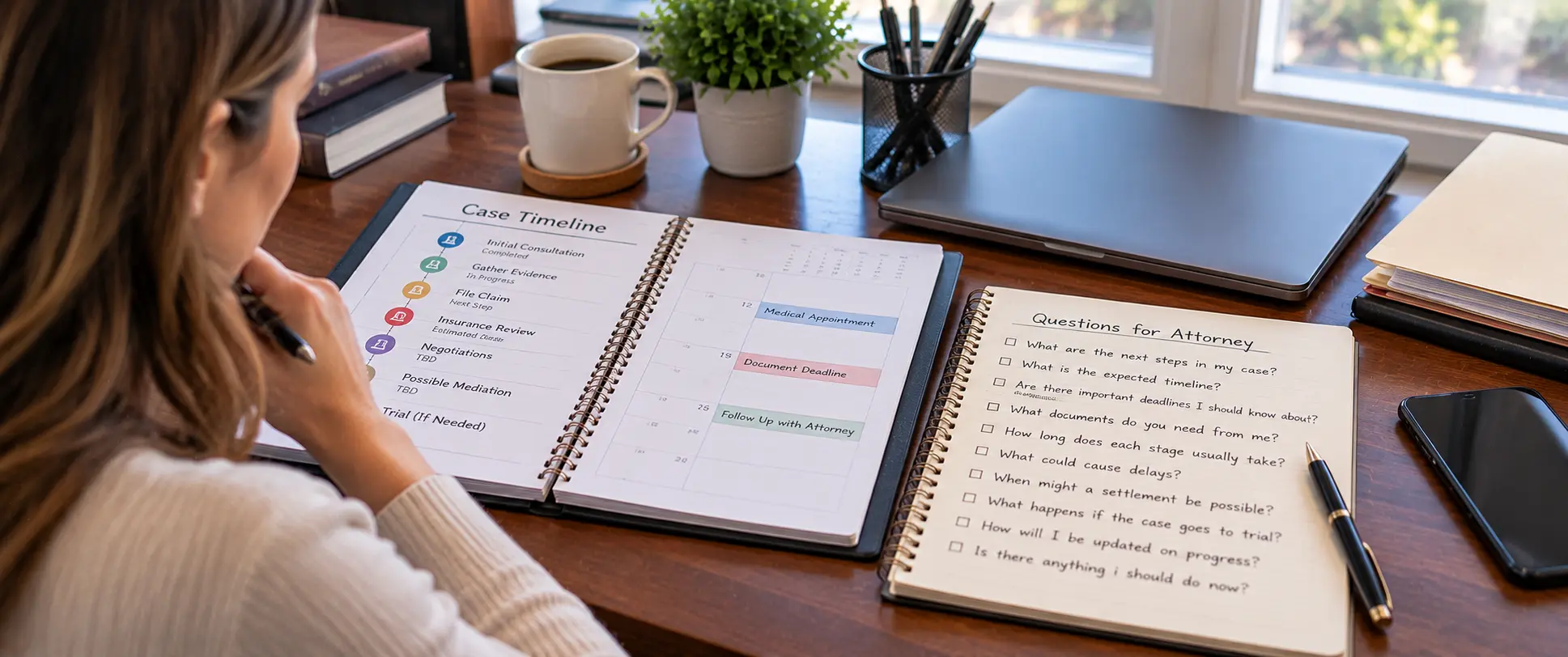
Preparing questions about case timelines helps individuals understand how a legal matter may progress, which deadlines deserve attention, and what circumstances could affect the overall schedule. Before meeting an attorney, clients can identify important dates, organize relevant documents, and prepare questions about expected procedures.
However, legal timelines are rarely completely predictable. The duration of a case may depend on the type of dispute, available evidence, negotiations, court schedules, and procedural requirements.
Therefore, understanding the difference between fixed deadlines and estimated timeframes is an important part of preparing for legal representation.
Why Questions About Case Timelines Matter
A legal case timeline describes the sequence of important events that may occur as a legal matter progresses.
Depending on the circumstances, these events may include an initial investigation, document collection, negotiations, filing requirements, discovery, and potential court proceedings.
Understanding these stages helps clients prepare for upcoming responsibilities. In addition, discussing timing expectations early can reduce misunderstandings about how quickly a matter may move forward.
However, an attorney generally cannot guarantee that every stage will occur according to an estimated schedule.
Important Questions About Case Timelines to Ask an Attorney
Prospective clients can use a consultation to clarify the expected progression of their matter.
The following questions help identify procedural stages, legal deadlines, and factors that may affect the schedule.
1. What Are the Main Stages of My Case?
Ask the attorney to explain the major steps that may apply.
For example, a personal injury matter may involve gathering medical documentation, evaluating liability, communicating with insurance companies, and considering settlement or litigation.
However, not every case follows the same sequence. Understanding the likely stages provides a practical starting point.
2. Are There Important Filing Deadlines?
Legal deadlines can affect whether a claim or legal action may proceed.
In New York, different types of legal matters may involve different statutes of limitations and procedural requirements. Certain claims involving public entities may also have shorter notice requirements.
Therefore, clients should ask which deadlines apply to their specific circumstances.
The New York State Unified Court System’s CourtHelp resources provide general information about New York court procedures and legal matters.
However, individuals should seek case-specific guidance rather than relying on general procedural information to calculate filing deadlines.
3. How Long Might Each Stage Take?
An attorney may be able to provide general timing expectations based on the nature of the matter.
However, these estimates depend on available information and may change.
For example, obtaining medical records or completing an investigation may require additional time.
Clients should ask which stages are relatively predictable and which involve greater uncertainty.
Questions About Case Timelines and Possible Delays
Several circumstances can influence how quickly a legal matter progresses.
Understanding these factors can help clients distinguish routine procedural delays from developments that require attention.
Evidence Collection and Investigation
Attorneys may need documents, witness statements, professional evaluations, or other supporting information.
If records are incomplete or difficult to obtain, the investigation may take longer.
For example, an attorney may need additional documentation before evaluating the available evidence or discussing possible next steps.
Settlement Negotiations
Settlement discussions can require multiple exchanges between the parties.
However, negotiations do not always produce an agreement. Consequently, additional legal proceedings may become necessary.
Clients should ask whether ongoing negotiations could affect upcoming procedural deadlines.
Court Scheduling and Legal Procedures
When litigation is involved, court calendars, motions, discovery disputes, and other procedural matters may affect timing.
These circumstances may be outside the client’s direct control.
Therefore, case estimates should allow for reasonable uncertainty.
Discussing Legal Case Timelines With an Attorney
Individuals seeking legal representation in Nassau County or Suffolk County may benefit from asking how local procedural requirements could affect their case.
For example, prospective clients researching Siben & Siben, LLP can review the Bay Shore firm’s published practice areas before arranging an appropriate discussion about their legal concerns.
During a consultation, individuals can ask which legal procedures may apply and whether particular deadlines require immediate attention.
However, general information about a law firm’s services cannot replace an individualized assessment.
The appropriate timeline depends on the facts, applicable law, and procedural status of the matter.
How to Prepare a Timeline of Important Events
Before speaking with an attorney, clients can organize a simple chronological summary.
This document may include:
- The date the incident or dispute began
- Important communications between involved parties
- Medical appointments, when relevant
- Insurance notifications
- Documents received or submitted
- Previous legal consultations
- Known filing or response deadlines
- Upcoming appointments or hearings
A clear chronology helps the attorney identify important dates.
In addition, clients should distinguish confirmed dates from estimates. If an event’s exact date is unknown, it is better to acknowledge uncertainty than to provide an inaccurate timeline.
Questions About Case Timelines and Communication Updates
Case timelines involve more than court dates and filing deadlines.
Clients should also understand how they will receive updates and learn about schedule changes.
Useful questions include:
- How often should I expect a case update?
- Who will contact me when an important development occurs?
- How will changes to the expected timeline be explained?
- What documents should I provide promptly?
- Who should I contact if I receive a legal notice?
- How will upcoming deadlines be communicated?
Clear communication expectations can help clients remain informed throughout the process.
However, the frequency of updates may depend on the activity occurring in the case.
What Happens When an Expected Deadline Changes?
Not every change in a projected schedule affects a legally required deadline.
For example, an attorney may revise an estimated investigation period because additional records are necessary.
In contrast, a court-imposed deadline may require a formal extension or another procedural response.
Therefore, clients should ask whether a scheduling change affects an estimate, a procedural requirement, or a legal deadline.
Can an Attorney Guarantee When a Case Will End?
Generally, an attorney cannot reliably guarantee an exact completion date.
Some legal matters resolve through early negotiations. Others require additional investigation, formal litigation, or court decisions.
Unexpected developments may also change the anticipated schedule.
Therefore, clients should distinguish a reasonable professional estimate from a guaranteed outcome.
An attorney can explain known deadlines and likely procedural steps while acknowledging factors that remain uncertain.
Common Mistakes When Discussing Legal Case Timelines
One common mistake is assuming that similar cases always take the same amount of time.
Another is confusing a filing deadline with the expected date of resolution.
In addition, clients may overlook important documents that establish when an event occurred.
Failing to ask about communication expectations can also create unnecessary uncertainty.
To avoid these problems, individuals should prepare their records, ask specific questions, and request clarification when timing estimates are unclear.
Final Thoughts on Questions About Case Timelines
Preparing questions about case timelines helps individuals approach legal consultations with clearer expectations and better-organized information.
Understanding procedural stages, filing deadlines, possible delays, and communication arrangements can make the legal process easier to follow.
For individuals considering legal representation in New York, discussing these matters early can support informed decisions while recognizing that every legal case develops according to its particular facts and circumstances.

